What Is a Wheel of Life Template and Who Uses It
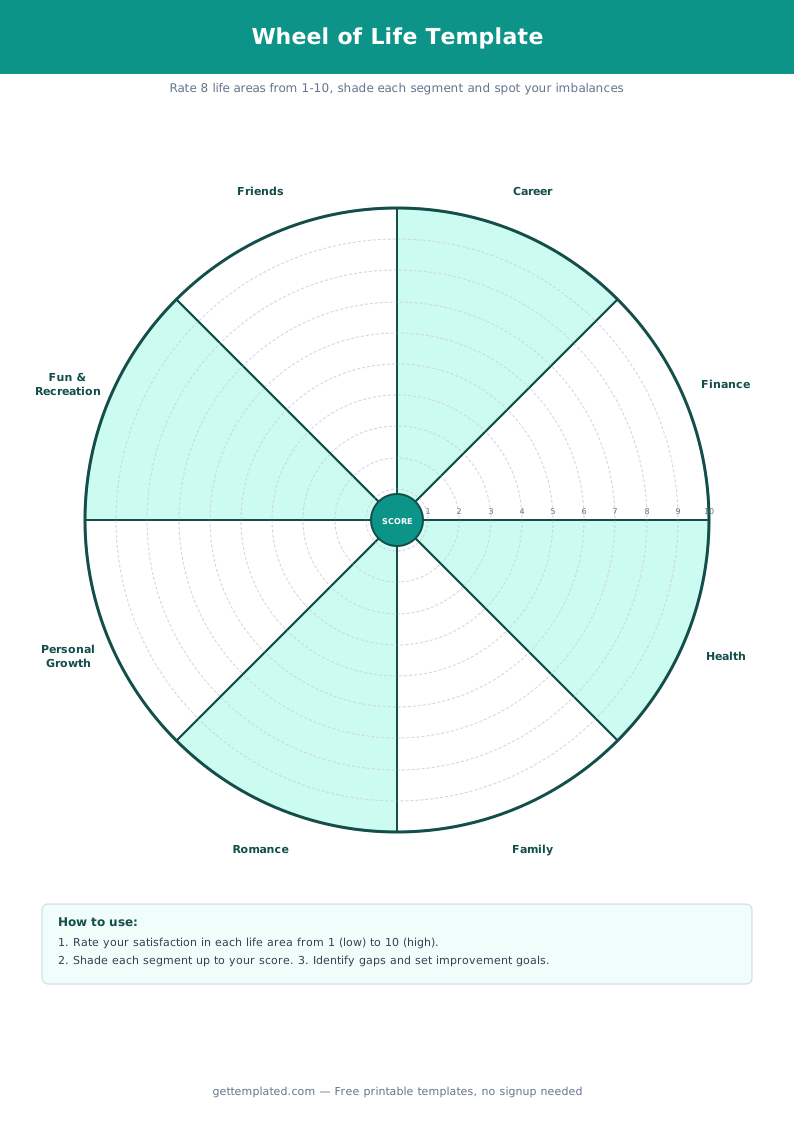
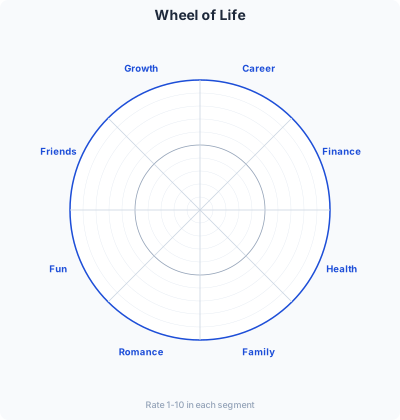
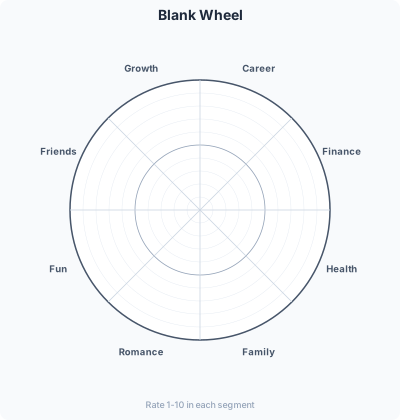
The wheel of life is a self-assessment framework that divides life into eight key areas and asks you to rate your satisfaction in each one on a scale from 1 to 10. When the scores are plotted on a circle divided into eight segments, the resulting shape shows you visually how balanced or lopsided your life currently feels. A life where every area scores 7 produces a smooth, round wheel. A life where work scores 9 and health scores 2 produces an uneven shape that is, metaphorically, difficult to ride.
The framework has been used by life coaches, therapists, and personal development communities for several decades as a starting point for goal-setting conversations. Its value is not precision. It is visibility. Most people know, somewhere in the back of their mind, that they have been neglecting their health or their friendships. The wheel of life template makes that knowledge concrete and hard to ignore.
Used as a quiz or scored assessment, the template can be completed in about five minutes and revisited every quarter to track whether the areas you decided to work on actually improved.
- Individuals doing annual or quarterly life reviews who want a visual snapshot of where they stand
- Life coaches and therapists using it as a starting assessment with new clients
- People going through major transitions (new job, divorce, retirement) who want to understand which areas of their life feel most destabilized
- Team leaders and managers who use it personally to spot before a burnout becomes a crisis
- Students in coaching or personal development courses who need a structured self-assessment tool
- Anyone who has been feeling vaguely dissatisfied and wants to locate the source
The Eight Areas of the Wheel of Life
The standard wheel of life template covers eight life areas. Some versions rename or split categories slightly, but these eight represent the core framework used most widely.
- Career and work: Your satisfaction with your job, the progress you are making professionally, your sense of purpose and contribution, and how your work aligns with what matters to you
- Finances: Your income, savings, debt situation, and overall sense of financial security and freedom
- Health and fitness: Your physical health, energy levels, sleep quality, and the consistency of your exercise and nutrition habits
- Family and close relationships: The quality of your relationships with your partner, immediate family, and the handful of people you are closest to
- Social life and friendships: Your wider social connections, the sense of community you feel, and whether you have enough meaningful contact with people outside your immediate household
- Personal growth and learning: Whether you are developing new skills, pursuing intellectual interests, and growing as a person in a way that feels meaningful to you
- Fun and recreation: How much genuine enjoyment, play, rest, and recreation your life contains, separate from work productivity
- Physical environment: Your home, workspace, and the places where you spend most of your time, whether they feel organized, comfortable, and supportive of the life you want
How to Complete the Wheel of Life Assessment
The wheel of life template takes about five to ten minutes to complete and is most useful when you treat it as an honest gut-check rather than an aspirational exercise.
- Open the free wheel of life template in Google Docs or print the PDF version.
- Read the first area (Career / Work) and ask yourself: on a scale from 1 to 10, how satisfied am I with this area of my life right now? Not how satisfied I want to be. How satisfied I actually am today.
- Write down the number that comes to mind first. Do not overthink it. The gut-level response is usually the honest one.
- Repeat for all eight areas without going back to change earlier scores. Changing scores based on how others compare is a way of avoiding what the lower scores are telling you.
- Look at the scores as a set. Notice the spread between your highest and lowest. A spread of 5 or more points between areas is common and is often where meaningful insight lives.
- Identify one or two areas you want to focus on over the next 90 days. These are not necessarily your lowest scores. They are the areas where improvement would make the biggest difference to how your life feels.
- Write one specific action you will take in each focus area. Not a vague resolution but a concrete behavior: 'I will go to bed by 10:30 pm on weeknights' rather than 'I will improve my sleep.'
- Set a calendar reminder to retake the assessment in 90 days and compare your scores.
Wheel of Life Variations: Quiz Format, Coaching Tool, and Team Use
The standard wheel of life template can be adapted in several ways depending on your purpose.
As a self-assessment quiz: Add a brief reflective prompt below each life area rating. For example, after the health score, write one sentence about what is driving the score and one action you could take. This transforms the template from a snapshot into a mini-journal entry that gives you more to work with.
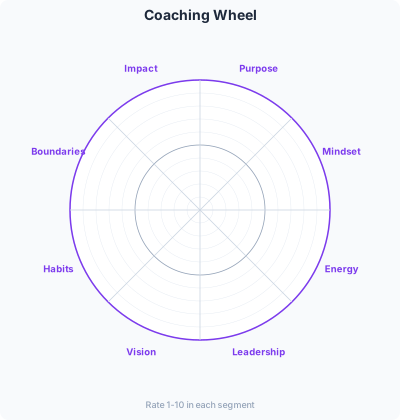
As a coaching tool: Coaches often ask clients to complete the wheel before a first session and bring it to the meeting. The coach uses the lowest-scoring areas as a starting point for conversation rather than jumping straight to goal-setting. The visual format makes it easy for both coach and client to reference during the session.
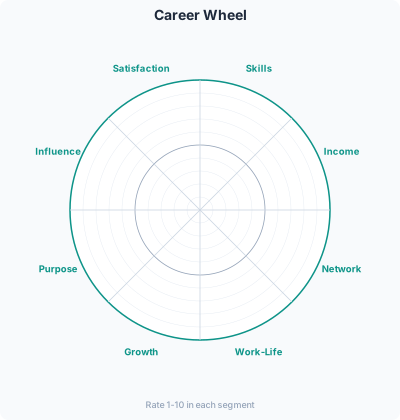
For teams and groups: Some managers use a modified wheel with work-relevant categories (project clarity, team communication, workload balance, skill development, recognition, etc.) as a team health check. This is most useful during retrospectives or after a demanding project cycle.
Interpreting Your Wheel of Life Results
The most important thing to understand about your wheel of life scores is that the goal is not to achieve 10 in every area. A perfect 10 across all eight areas would require an impossible allocation of time and energy. The goal is to make conscious, deliberate choices about where your energy goes rather than letting the defaults of daily life make those choices for you.
A few patterns are worth knowing when you look at your completed template.
- High scores across the board with one or two deep dips: The low areas are almost always the ones you have been avoiding thinking about. This is the most common pattern and usually the most actionable.
- Uniformly low scores: This often reflects burnout, depression, or a life in transition. The first move here is usually a single sustainable change in one area rather than trying to improve everything at once.
- High work, low health and relationships: Extremely common and well-documented as a pattern that precedes burnout. The wheel makes the trade-off visible in a way that vague dissatisfaction does not.
- Low fun and recreation: Often rationalized as 'I will relax when things calm down.' The wheel helps you see that this area has been consistently deprioritized across multiple quarters.
- Scores that do not change quarter to quarter: The specific action you committed to was probably too vague. 'Improve my finances' is not an action. 'Set up automatic savings of $200 per month by the 5th' is an action.
Wheel of Life Template Formats: Printable and Google Docs
This free wheel of life template is available in formats that suit different working styles.
Printable wheel of life template (PDF): Download and print the PDF. Fill in your scores by hand and sketch the wheel segments. Many people find that writing on paper helps them be more honest with themselves than typing. The printable version also works well in coaching sessions where you want a physical artifact to discuss.
Wheel of life template in Google Docs: Open the template in your browser, make a copy to your Drive, and complete it digitally. The Google Docs version is easy to share with a coach, save for comparison against future assessments, or duplicate for a partner or family member to complete independently.
Both formats are free and require no account or signup to download.
The template