What a Fishbone Diagram Is and Who Uses One
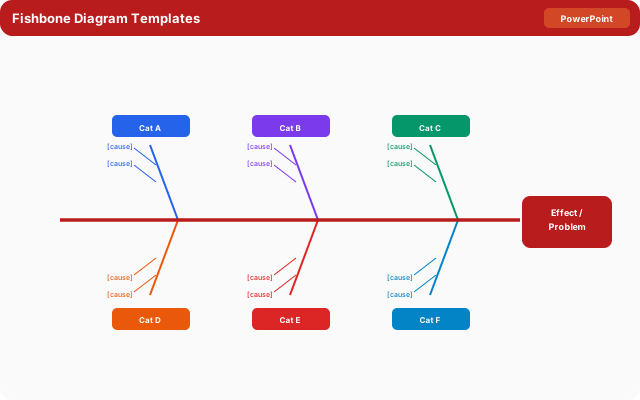
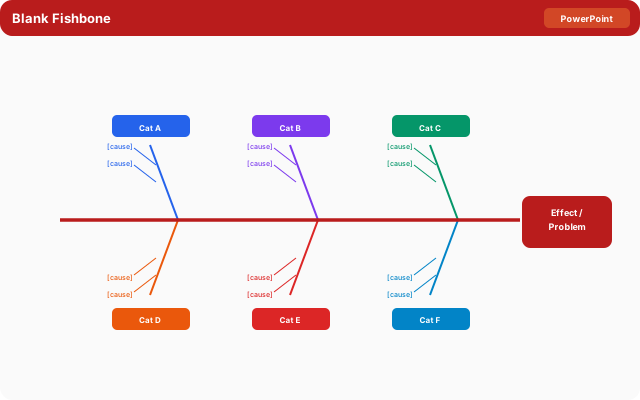
A fishbone diagram is a cause-and-effect visualization invented by quality engineer Kaoru Ishikawa in the 1960s. The diagram looks like a fish skeleton: the problem or defect sits at the far right as the fish's head, and the main categories of potential causes branch off a central horizontal spine like the bones of a fish. Each main bone branches further into specific contributing causes.
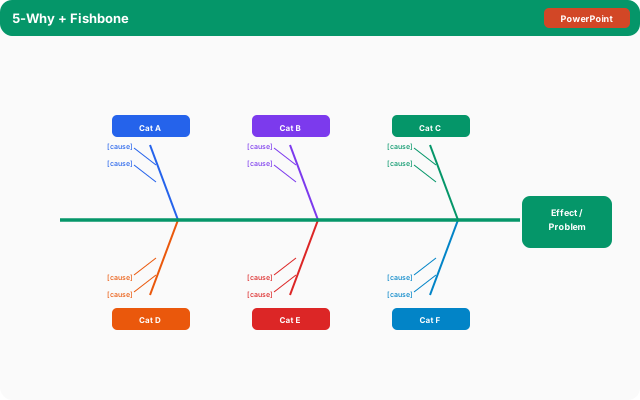
The diagram is used in quality management, manufacturing, healthcare, software development, and any environment where a recurring problem needs to be traced to its root cause rather than just patched at the surface. Quality teams in manufacturing use it to investigate product defects before they reach customers. Healthcare organizations use it to analyze adverse events. Software teams use it to investigate production incidents. Six Sigma and lean practitioners use the fishbone diagram as a standard tool in the Define-Measure-Analyze-Improve-Control process. It also pairs naturally with the 5 Whys technique: the fishbone identifies the category, and then the 5 Whys drills down to confirm the specific root cause.
- Quality teams investigating product defects or process failures
- Manufacturing and operations teams analyzing recurring production problems
- Healthcare teams reviewing adverse events and near-misses
- Software and IT teams conducting post-incident reviews
- Six Sigma and lean practitioners working through improvement cycles
- Business analysts mapping the causes of a poor customer experience or service failure
What to Include in a Fishbone Diagram Template
A complete fishbone diagram template includes the problem statement, the main cause categories, space for specific causes under each category, and a section for recording the confirmed root cause and corrective action. The categories vary slightly by industry, but the most common frameworks are the 6M model for manufacturing and the 4P model for service environments.
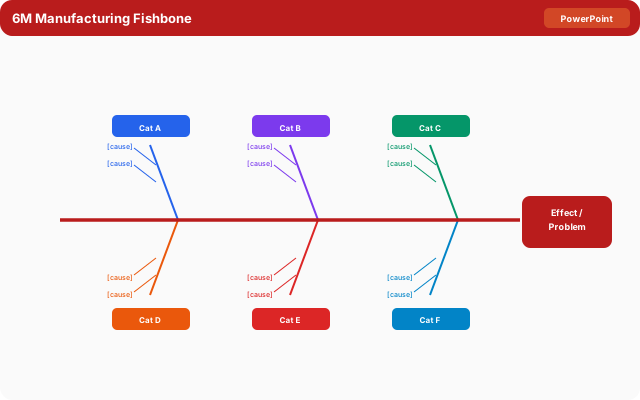
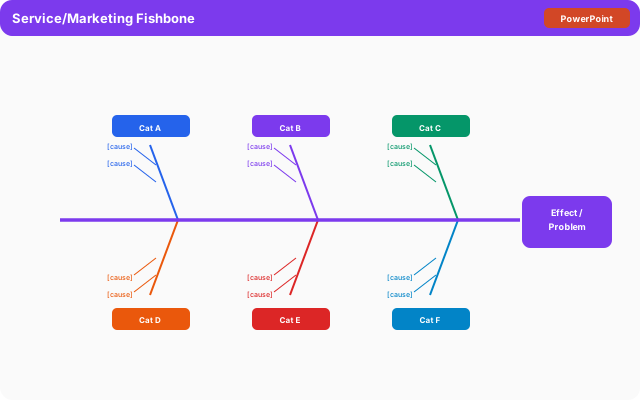
The 6M categories are: Machines (equipment), Methods (processes), Materials, Measurements, Man (people), and Mother Nature (environment). The 4P service model uses: People, Processes, Place, and Policies. Either set works as a starting structure; use the one that fits your context, or replace categories with ones specific to your problem. The goal is to make sure no major area of potential causes is missed.
- A precise problem statement at the head of the diagram describing the effect being analyzed
- Main cause categories branching off the spine (6M or 4P are the standard frameworks)
- Specific causes listed under each category, generated through team brainstorming
- Sub-causes branching off each specific cause for deeper analysis when needed
- A root cause confirmation section where the most likely causes are tested against data
- A corrective action row with the identified fix, the owner, and a target completion date
- Date, team members, and version number so the analysis can be referenced later
How to Run a Fishbone Diagram Analysis
A fishbone diagram works best as a facilitated team activity, not a solo exercise. The value comes from combining perspectives across functions: the person who operates the process, the person who monitors quality, the manager who sets procedures, and any supplier or customer representatives if relevant. Plan 45 to 90 minutes for the session depending on the complexity of the problem.
- Write a precise problem statement before the session begins. A vague statement like 'quality is bad' produces vague causes. A precise statement like 'the defect rate on the final assembly line exceeded 3.5% in the last two production runs' gives the team a specific target to analyze.
- Draw the fishbone structure or open the template and write the problem statement in the head box on the right.
- Add your main cause categories as labeled diagonal bones off the spine. Use the 6M categories for manufacturing or operations. Use People, Process, Place, Policy for service environments.
- Facilitate team brainstorming for each category. Ask: what in this category could cause this problem? Write each cause idea as a sub-bone under the relevant main category. Do not evaluate or filter ideas during brainstorming.
- For any cause that seems significant, ask why it occurs and add the sub-cause as a smaller branch. This is where the fishbone connects to the 5 Whys technique.
- After brainstorming, have the team vote on the two or three most likely root causes based on their experience and any available data. Circle or highlight these on the diagram.
- Test the most likely root causes against actual data: review records, run a quick measurement, or check if the problem disappears when the suspected cause is temporarily removed.
- Document the confirmed root cause and assign a corrective action with an owner and due date. File the completed diagram with the corrective action record.
Related Root Cause and Decision Analysis Templates
The fishbone diagram is one tool in a broader toolkit for problem analysis and decision-making. Several related templates are commonly used alongside it or as alternatives depending on the nature of the problem.
A 5 Whys template structures the iterative questioning process: you state the problem and ask why it occurred, then ask why that cause occurred, repeating five or more times until you reach a root cause that can be acted on. A decision matrix template, also called a weighted decision matrix, helps teams choose between multiple options by scoring each option against weighted criteria. A RACI matrix template maps project tasks to roles using four designations: Responsible, Accountable, Consulted, and Informed. This clarifies who does what and who approves decisions, which often surfaces ownership gaps that contribute to recurring problems.
- 5 Whys template: iterative questioning that drills through layers of causes to reach the root
- Root cause analysis template: a complete RCA document combining fishbone, 5 Whys, data, and action planning in one place
- Decision matrix template: a weighted scoring tool for choosing between multiple options objectively
- RACI matrix template: maps tasks to roles using Responsible, Accountable, Consulted, and Informed designations
- RACI chart template: a visual layout of the RACI matrix showing role assignments across a project or process
Common Mistakes and Tips for Effective Fishbone Analysis
The most common fishbone diagram mistake is using it to assign blame rather than to find systemic causes. If the analysis consistently lands on human error as the root cause without going deeper, the team is stopping too early. Human error is almost always the result of a system problem: unclear instructions, inadequate training, missing tools, or poor process design. Ask why the human error occurred and you will find a system cause that can actually be fixed.
A second common problem is running the fishbone analysis without data. A diagram full of opinions produces a corrective action based on opinions. The most useful fishbone sessions combine team knowledge with actual measurements, logs, or records that confirm or rule out suspected causes.
- Write a specific, measurable problem statement before the session, not a vague complaint
- Use a cross-functional team so every category gets input from someone close to that part of the process
- Do not stop at human error as a root cause; ask why the error occurred to find the system cause
- Support the most likely causes with data before assigning corrective action
- Assign every corrective action to a named owner with a due date, not to a department in general
- Keep completed fishbone diagrams in a shared location so teams can check whether a problem has been analyzed before
The template